



Karen Baker
HR/Personnel Director, Director of Student Services, Letcher County Public Schools
This guest blog comes from a valued partner of PRI, Letcher County Public Schools, and reflects our shared commitment to amplifying rural brilliance. Across the country, rural communities are improving outcomes for students, and we are proud to help elevate these bright spots.
Imagine living in a place where streetlights don’t illuminate the sky when the sun goes down. Where sidewalks exist only on Main Street. Where the only feasible modes of transportation are a vehicle or a school bus—public transportation is nonexistent. Where rugged mountains, a 3,700-foot peak and the Jefferson National Forest define the terrain. A place that 20,000 people—and a couple of grouches—call home. If you can imagine this, you’ve imagined Whitesburg in Letcher County, Kentucky.
This background helps explain how the culture has been shaped by our geography. Being connected to one another takes effort when often a couple of miles or more separates neighbors. And, depending on who you ask, we’re southern(ish). Connection to family and community isn’t optional—it’s serious business.
Before the 2020 pandemic, Letcher County Public Schools had the lowest chronic absenteeism rate in southeastern Kentucky—just 4%. (For those who aren’t educators, chronic absenteeism means missing 10% of the school year, excused or unexcused.)
However, all that changed after Covid. To make matters worse, in July 2022, southeast Kentucky experienced a 1,000-year flood that destroyed homes and school buildings and caused major housing insecurity for students. As a result of these and other factors, in the 2023-24 school year, our chronic absenteeism spiked to 61%. Out of a district population of 2,600, that’s almost 1,600 kids who missed at least 18.5 days of school. The data was heartbreaking, and we knew we had to make changes, big and small. We were already using the usual interventions—tiered incentives, targeted supports, counseling referrals and other measures when necessary. But when families are recovering from both a pandemic and a catastrophic flood, basic needs can take priority over attendance.
That’s when we teamed up with Dr. Anthony Maxwell and Partners for Rural Impact to become part of the Appalachian Attendance Collaborative. We formed a district attendance team and started brainstorming ways to improve connection while continuing our traditional interventions.
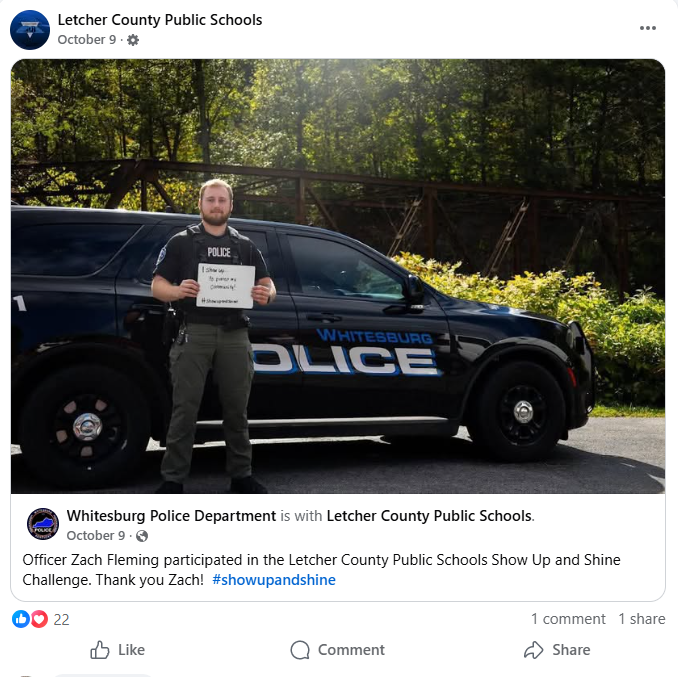
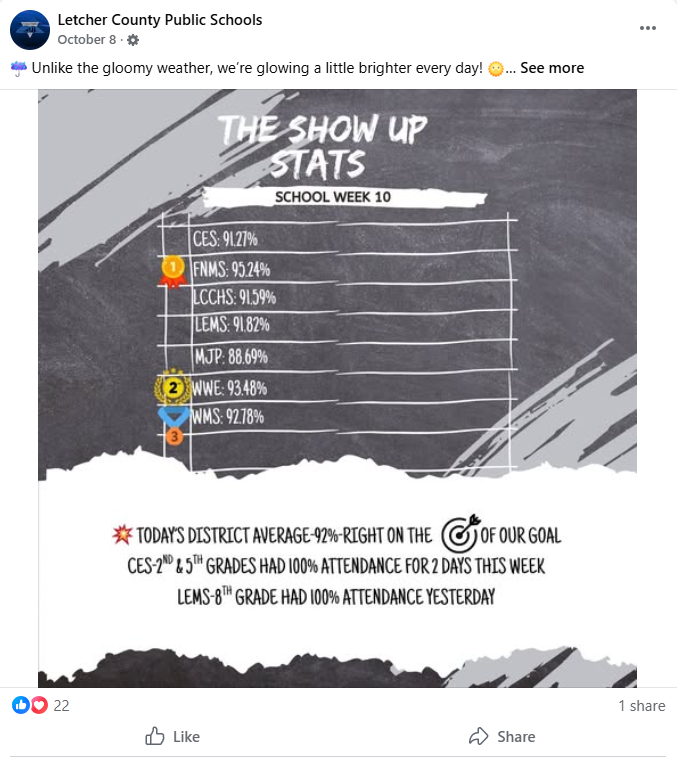
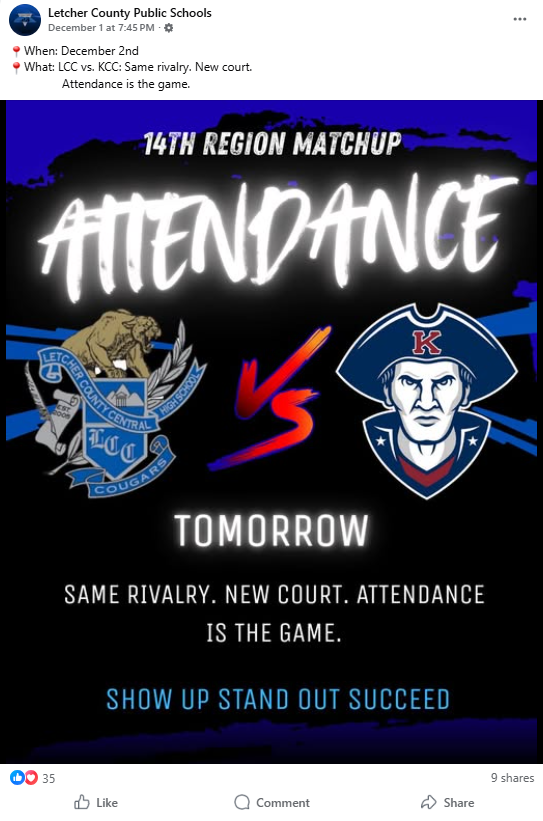
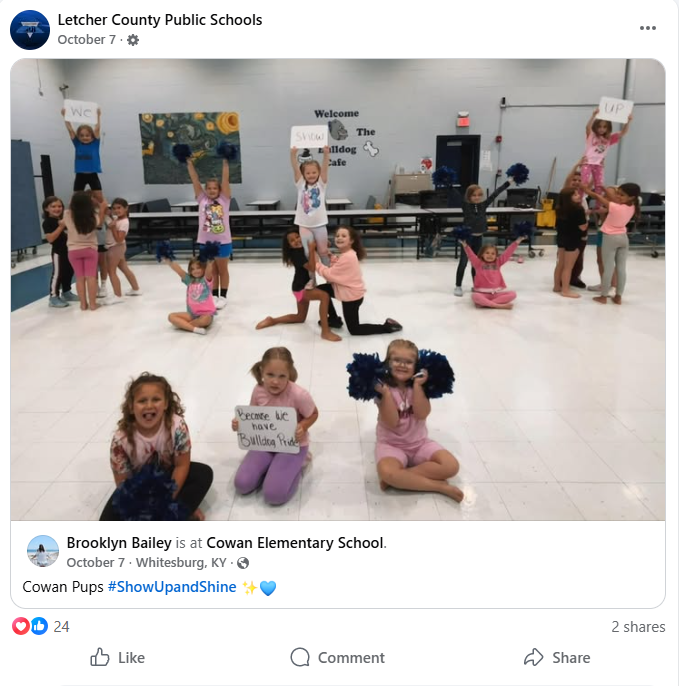
We needed to stay connected to students in a meaningful way. To make school the place they actually wanted to be—where they feel loved, heard, seen and connected to someone in the building. That’s how our attendance campaign, “Show Up, Stand Out, Succeed!” was born. What started as a small plan to reach students grew into something bigger than we could have anticipated, in ways we never imagined. We started small by pushing our campaign in our schools and on the radio and Facebook—running campaigns that encouraged attendance and promoted incentives. Within a year, chronic absenteeism dropped from 54% to 38%. A huge improvement for a modest push.
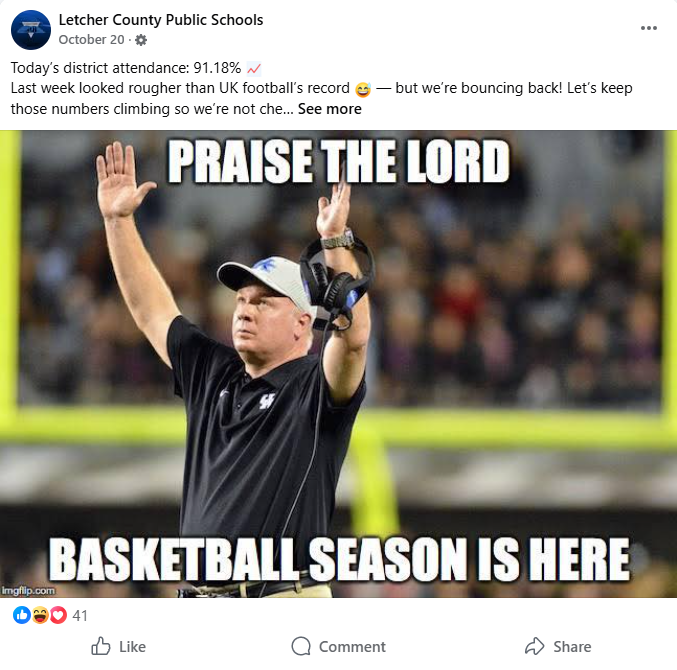
But we weren’t done. Daily attendance hovered around 88%, but we wanted more. Enter social media. Kids these days are media natives, living on platforms full of memes, TikTok trends and ever-changing lingo. So we asked ourselves, if businesses can capture attention through media, why can’t the school system? Humor is a universal connector: it breaks down barriers, grabs attention and makes messages stick. It even helps heal a little of something in all of us. By weaving fun, playful and even slightly outrageous content into our campaign, we caught students’ eyes, made them laugh and reminded them that school is a place where they’re seen, valued and part of a community.
We learned a well-timed joke or unexpected stunt speaks louder than a flyer or email ever could.
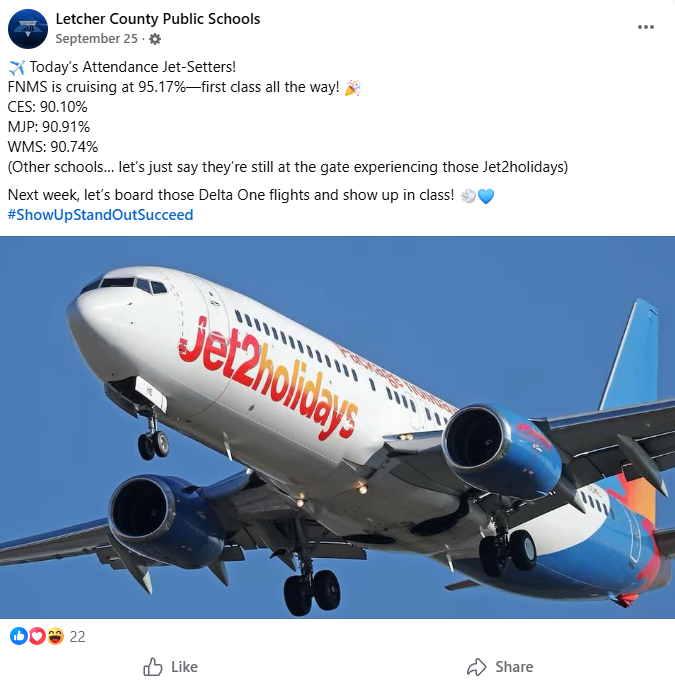
This school year, we added a student media intern to our district attendance team which gave us greater insight into student minds (a scary place, but all jokes aside, it’s been priceless). Our campaign has grown from Facebook and radio—where us oldies mostly remain—to a full-blown social media blitz across TikTok, Instagram and Facebook. We’ve had WWE-style throwdowns between principals to promote High Attendance Day, regular appearances by our superintendent in TikTok trends, a hype video leaked on the Jumbotron during Friday Night Lights (and yes, a few people almost lost their jobs) and even rumors that we hired an outside agency to run our campaign.
To date, in the 2025–26 school year, our daily average attendance is 91%, and chronic absenteeism has dropped to 33%. The data shows our students are slowly healing from the trauma of the past five years. And yes—we credit the late actor Leslie Jordan a little in our road to success. Just as he connected people on TikTok during a global pandemic, his “What are y’all doing?” meme became an unexpected win for our district, leaving some folks wondering…who is really running our social media page now? Honestly, I’d have come to school just to see what would happen next—and it seems our students feel the same way.
Behind this progress is a deeper, strategic effort to ensure every student is supported. Letcher County’s Student Success Planning initiative, now central to the district’s attendance strategy, began after the community was accepted into the Harvard Graduate School of Education’s Education Redesign Lab Student Success Planning cohort, a national network focused on improving student outcomes. Like many participating communities, Letcher County identified chronic absenteeism as a key priority.
The local Student Success Planning team—PRI’s Christian Callihan, Angie Hampton and Safia Sykes, Letcher County Public Schools Superintendent Denise Yonts and Letcher Elementary School Principal Jennifer Caudill—has partnered closely with Harvard to build an approach grounded in the belief that every student should be seen, valued and supported. The work combines comprehensive student supports with implementation of the Check & Connect program and staff training to ensure long-term sustainability.
With ongoing coaching from the EdRedesign Lab, the team continues to refine its strategy and strengthen outcomes. This momentum would not be possible without the guidance and partnership of the EdRedesign team at Harvard.
Learn more about the Harvard EdRedesign’s Institute for Success Planning at edredesign.org/our-work/institute-success-planning.

Connecting with Our Students through Humor
This guest blog comes from a valued partner of PRI, Letcher County Public Schools, and reflects our shared commitment to amplifying rural brilliance. Across the

An Opportunity to Invest in Your Child: Understanding Trump Accounts
Building Long-Term Financial Security for Millions of Children: Tax-Advantaged Investment Accounts Coming in 2026 Beginning in 2026, a new and innovative program known as Trump
Showing Up Together: Stories of Attendance in Action
When September began, I asked a simple question: “Why be at school?” Over the past few weeks, I’ve seen that question answered in classrooms, homes,
The Power of Striving Together
Last week I had the opportunity to attend my first StriveTogether Cradle to Career Network Convening. On my flight to Atlanta, I kept thinking about

One of 15: Rosie Stafford Earns Prestigious GPC Certification
We are thrilled to share that our Program Manager, Rose-Linda “Rosie” Stafford, has joined an elite group of just 15 professionals in Kentucky to earn

Why Be at School? Because the Future Is Built One Day at a Time
As National Attendance Awareness Month begins, I think back on 30 years in education—and it’s not the ceremonies or milestones I remember most, but the